 It is tragic what is happening in America today. Few Americans are
aware of just how COMMUNIST our
nation has become. U.S. citizens are having strangers stick their hands
down your pants and skirt. Women's breasts are being groped and squeezed to
search for explosives.
It is tragic what is happening in America today. Few Americans are
aware of just how COMMUNIST our
nation has become. U.S. citizens are having strangers stick their hands
down your pants and skirt. Women's breasts are being groped and squeezed to
search for explosives.
If you think this is about protecting us from terrorists, you're a darn fool, and a big one at that! This is about breaking the will of the American people. If the government can condition us to accept being molested at TSA checkpoints, then they can get away with just about anything.
Our founding father's never envisioned a time in the future when female citizens would be groped at America's airports as a requirement to travel. This is not freedom. The "War On Terror" is in reality a war on Americans!
According to Diana Fairechild, who flew over 10 million miles as an international chief purser for Pan Am, in an article titled BREAST GROPING AT AIRPORT SECURITY; WHAT SMART WOMEN CAN DO, she states...
What should you do if an airport security person insists on feeling your breasts. Is this a joke? Or do passengers actually have to go along with this intrusion?
Women's breasts are sensitive and women are sensitive about their breasts. And we certainly don't want our breasts examined at airports, and especially not out in the open giving male screeners and male passengers an opportunity to enjoy the show.Last month, a female screener told a young mother: "I'm going to feel your breasts now." The mother begged, bawled, balked, and was finally denied boarding.
The Transportation Security Administration (TSA) said its screener did nothing wrong and that touching breasts became a security priority in September 2004 after two Russian jetliners exploded, possibly from bombs smuggled in clothing of two women of Cechnya origin.
After she was denied boarding, Ava Kingsford stuck by her personal principles and decided to drive a rental car from Denver Airport to her home in San Diego. It took 16 hours including too many stops with her little baby.
In addition, Ava's luggage (with diapers, clothes, etc.) had not been retrieved by the airline (against FAA regulations, by the way), though she had waited at the airport several hours for it.
In a phone interview, Ava told me that two female airport screeners had taken her to a back room to touch her breasts. To avoid being touched, Ava pulled down her tank top and bra-less said: "See, I'm not hiding anything."
But, incredibly, the screener replied: "That's it. You just flashed us and you're not boarding your plane."
This was obviously less about passengers terrorizing airplanes, and more about screeners intimidating passengers. For what it's worth, I believe TSA's boob groping policy is a ploy to intimidate passengers into accepting full-body-scan machines at all U.S. airports...
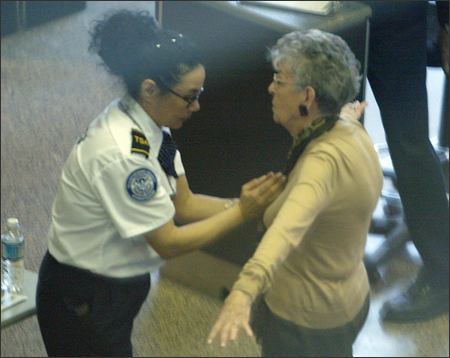
This type of abuse happens every day in airports all across America, and good women everywhere are getting mad...
"Rhonda L. Gaynier, a New York lawyer, is hopping mad because, she says, getting on an airplane these days means being groped by a stranger. According to her and others, groping of airline passengers has increased since the Transportation Security Administration issued new guidelines recently requiring checkpoint screeners to conduct more frequent, and more intimate, pat-downs..."
SOURCE: http://www.nytimes.com/2004/11/02/business/02road.html
The American people are to blame, because they tolerate such infringements of their privacy, person, and rights. Freedom is NOT free, and we will ultimately become slaves to a New World Order of Communist thugs if we don't fight now. Please read The Communist Subversion of America.
Diana Fairechild of www.flyana.com gives advise to traveling women...
1) If you believe you have been treated in a discriminatory manner, don't bother reporting it to airport authorities -- report it to the media. The TSA's so-called "resolution line" (866-289-9673) is just a recording that sends you to a website.
2) Make sure your bags are always in your sight. If a screener wants to move you to a side area or a private room and separate you from your hand luggage, politely insist that your handcarries must go where you go. They will comply.
3) Be polite. No matter how a screener behaves, control yourself and do not raise your voice as this could send you straight to jail.
4) If you feel tense at security, say to the screener: I appreciate that you are checking all the passengers thoroughly because I am also very concerned with safety.
Breast Grouping is wrong. Perhaps a woman who dresses immodestly, having loose morals, wouldn't mind a stranger molesting her with a probe or search instrument. However, a God-fearing woman who keeps herself pure, saving herself only for her husband, would be extremely offended, even feelings violated, if some man were to search her body crevices with a security device. Then again, what do you expect from a society that sees no harm in murdering babies!
Congress To Fund Massive Expansion Of TSA Checkpoints
Ron Paul Slams “Out Of Control Police State” After Rand Paul Detained By TSA
TSA Trains Hot Dog Vendors to Watch for Terrorists at Ball Games (terrorism is a big scam!)
Jesse Ventura Calls For NFL Boycott Over TSA-Style Groping (Nazi-fascism in America)
Former Governor Jesse Ventura Strikes Back with Lawsuit Against TSA for Groping
You are the
resistance America!
(and if you're not, something is wrong with your walk with God!)
Had your crotch searched lately by TSA? Just take a flight! They'll squeeze your breasts, look down your skirt, maybe even do a cavity search if you look suspicious! I'm not kidding...
Homeland Security Thugs Force 95-Year Old Elderly Woman in Wheelchair to Remove Her Diaper
Adolf Hitler would have given a right arm for the tyrannical power that the global criminal elite have over America today via the CIA, FBI, BATF, White House, Pentagon, FEMA, the mainstream Newsmedia, Hollywood, et cetera. The government even has a paid liaison working in Hollywood to incorporate brainwashing propaganda into the movies Americans love to watch. Here's one example.
The truth is so shocking that the average person refuses to believe that evil political, intelligence and military leaders lurking within our own government could be so evil as to deliberately murder 2,745 people on 911. Well, it's true whether you accept it or not! Wake up America!!!