|
Invisible RFID Ink for Humans
By David J. Stewart
Mark of
the Beast technology is here. Technology has advanced astronomically
over the past decade, and if we live to see the next 25-years of the
future, only God in Heaven knows what men will be capable of. The
following information clearly shows that for the first time in
mankind's history, we now have the technology to place an invisible
Radio Frequency Identification Device (RFID) on a person's
skin.
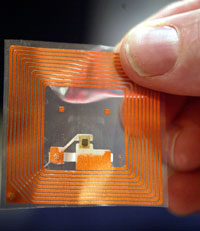
Photo to right: an RFID tag. These
devices can now be printed with invisible ink onto human beings
for tracking, data storage, and to make financial transactions
of every sort, even calculating costs.
RFID tags are an
improvement over bar codes because the tags have read and write
capabilities. Data stored on RFID tags can be changed, updated
and locked. Some stores that have begun using RFID tags have
found that the technology offers a better way to track
merchandise for stocking and marketing purposes. Through RFID
tags, stores can see how quickly the products leave the shelves
and who's buying them.
In addition to retail merchandise, RFID tags have also been
added to transportation devices like highway toll passcards and
subway passes. Because of their ability to store data so
efficiently, RFID tags can tabulate the cost of tolls and fares
and deduct the cost electronically from the amount of money that
the user places on the card. Rather than waiting to pay a toll
at a tollbooth or shelling out coins at a token counter,
passengers use RFID chip-embedded passes like debit cards.
SOURCE:
HowStuffWorks "Reinventing the Bar Code"
People
have no clue just how much a part of our everyday lives RFID's are
becoming. We'll soon be able to shop for items and walk out of a
grocery store without checking out. The items will be RFID scanned
and your bank charged for the items to your account.
Invisible RFID Ink Safe For Cattle And People, Company Says
The process involves
micro-needles and an ink capsule to create a stamp that can be
read from four feet away
By K.C. Jones —
InformationWeek
January 13,
2007
A
startup company has developed a chipless radio frequency
identification ink that it says has been successfully stamped on
cattle and read from as much as 4 feet away.
The
most common RFID systems, such as those used for toll-road
passes or for tracking merchandise in warehouses, contain a chip
and antenna. The process revealed by Somark Innovations last
week uses an array of microneedles and an applicator with a
one-time-use ink capsule to stamp an animal. The ink can be
colored or invisible, and applied through fur.
The
company sees a market for the passive RFID technology to track
cows in order to reduce financial losses from cases of mad cow
disease. Somark, formed in 2005 in St. Louis, is raising venture
financing and hopes to license the technology for use with
laboratory animals, dogs, and cats; for tracking prime cuts of
meat; and even for tracking military personnel.
Ranchers might want an invisible stamp in order to make it more
difficult for cattle thieves to tell which animals have been
marked. Today, cattle are often tracked with ear tags.
Current chipless RFID systems include
those with metal fibers embedded in paper and packaging
materials. Other uses include tracking documents, preventing
counterfeits, and creating "smart labels."
READ MORE
How RFID Works
|